



Imagine this: It’s 3 AM, and your CFO is staring at mismatched reports. Sales says inventory is fine, but the warehouse is screaming about stockouts. Finance is chasing invoices that should have been automated months ago. Your growing business feels like it’s being held together by spreadsheets and sheer willpower.
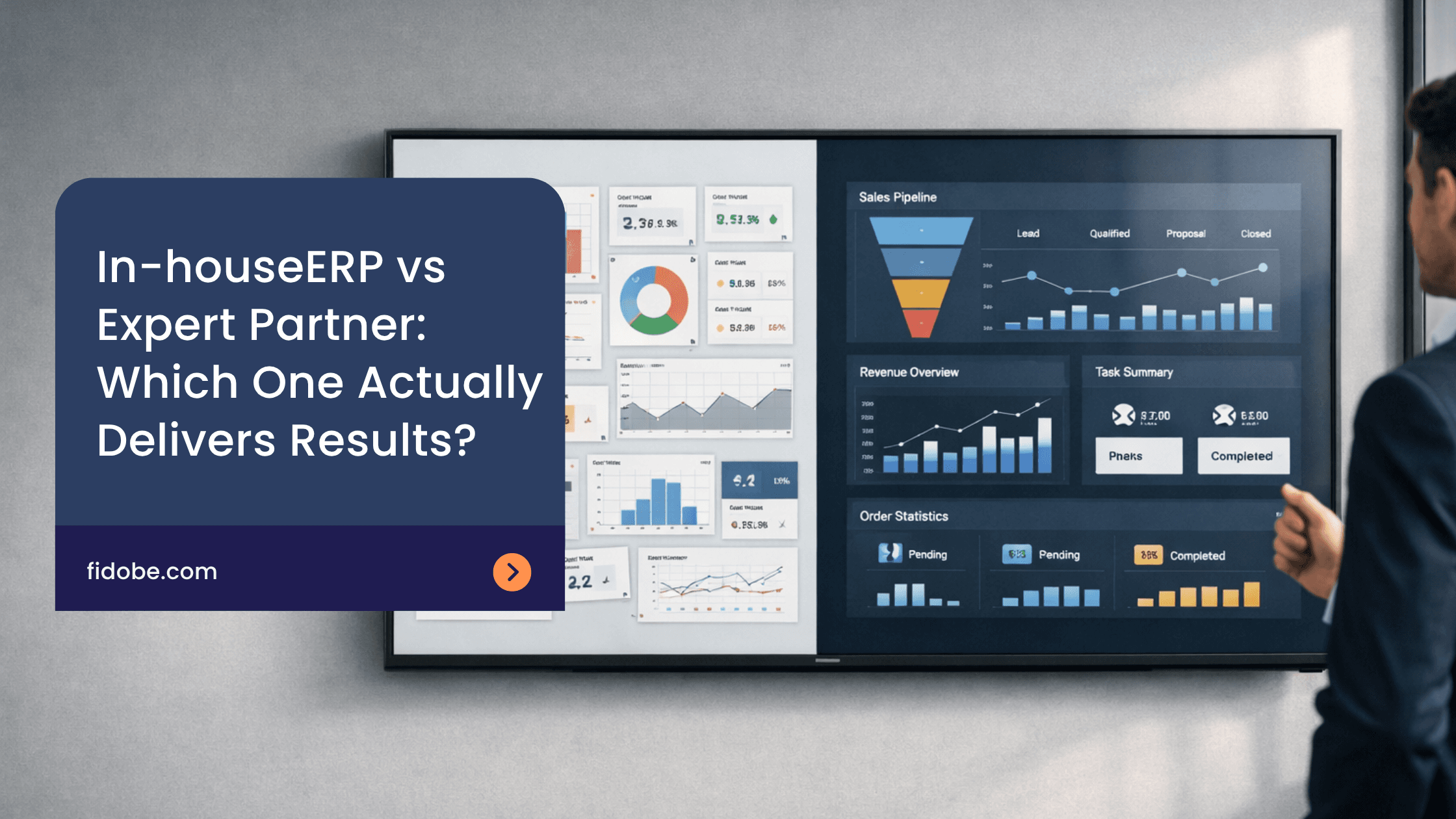
You know the solution a solid ERP system that ties finance, inventory, sales, procurement, HR, and operations into one seamless platform. But as soon as you start researching, the big dilemma hits: Should we handle the entire ERP project in-house with our own team, or bring in an expert ERP implementation partner?
This isn’t just a tech decision. It’s a high-stakes choice that affects your cash flow, employee morale, customer satisfaction, and how fast (or slow) your company can scale in 2026’s uncertain economy.
Many businesses have learned the hard way that picking the wrong path can turn a promising growth tool into a multi-million-rupee nightmare. Let’s dive deep into what in-house ERP really means, how an expert partner changes the game, and when each (or a smart hybrid) actually delivers results.
What Does In-House ERP Management Mean?
In-house ERP management means your internal team takes complete ownership of the project from start to finish. Your IT department (or a newly assembled group) evaluates software options, handles vendor negotiations, designs custom workflows, manages data migration, trains users, tests the system, and then maintains and upgrades it ongoing.
It’s like deciding to build and run your own professional kitchen instead of hiring a restaurant consultant. You choose every appliance, design the layout exactly to your taste, and keep every recipe secret. No outsider dictates the menu.
The big attractions are clear:
- Total control: You decide every customization, no matter how unique your processes are.
- Long-term knowledge retention: Everything your team learns stays inside the company.
- Potential cost savings over time: If you already have talented IT staff, you avoid hefty consultant fees.
For companies in highly regulated industries or those with extremely specialized operations (think custom manufacturing or defense-related businesses), this level of ownership feels essential for data sovereignty and compliance.
However, reality often bites. Most internal teams are already stretched thin managing day-to-day operations. Suddenly they’re expected to become ERP experts overnight. The learning curve is steep, and small mistakes compound quickly.
What is an ERP Partner?
An ERP partner sometimes called an implementation consultant, system integrator, or managed service provider is an external team that specializes in ERP systems. They’ve implemented the same software (or similar ones) for dozens or even hundreds of companies, often in your specific industry.
They bring battle-tested methodologies, industry best practices, pre-built templates, risk-mitigation frameworks, and deep troubleshooting experience. Think of them as professional chefs and kitchen designers who have opened 50 successful restaurants. They still cook to your exact preferences, but they know which tools cut prep time in half and which ingredients will ruin the dish.
Partners handle everything from software selection and gap analysis to configuration, data migration, change management, user training, and post-go-live support. Many also offer ongoing managed services for maintenance and optimization.
In today’s cloud-heavy world, good partners help you avoid common pitfalls like over-customization that makes future upgrades painful.
Key Comparison: In-House vs ERP Partner
Let’s break it down honestly with real factors that matter in 2026.
Control
In-house gives you absolute control every button, every report, every workflow is built exactly as your team wants. With a partner, you still make final decisions, but you lean on their recommendations. This can feel like less control initially, but it often leads to better outcomes because partners push back on unrealistic customizations that would create long-term headaches.
Cost
In-house can appear cheaper if you have an existing skilled team. However, hidden costs pile up fast: salaries for dedicated staff, training programs, infrastructure, opportunity cost of delayed projects, and potential overruns. Studies show many in-house efforts end up costing more due to extended timelines.
Expert partners usually charge higher upfront project fees, but they often deliver lower total cost of ownership. Implementation is faster (reducing lost productivity), errors are minimized, and you avoid building a large permanent specialized team. For small and mid-sized businesses, cloud ERP implementations with a partner can range from ₹50 lakh to several crores depending on scope, while pure in-house can stretch timelines dramatically.
Speed and Expertise
This is where the gap is widest. In-house projects frequently take significantly longer because the team is learning while doing. An experienced partner can cut implementation time dramatically by applying proven frameworks and avoiding common mistakes.
ERP implementation failure rates remain shockingly high estimates range from 47% to 75% of projects failing to meet objectives, going over budget (sometimes by 189%), or being abandoned entirely. The biggest culprits? Lack of expertise, poor change management, and underestimating complexity. Partners who have seen these failures dozens of times dramatically reduce your risk.
Scalability and Risk
In-house scalability depends on your ability to hire and retain expensive ERP talent. If a key team member leaves, institutional knowledge walks out the door. Partners offer flexible scaling ramp up during implementation or upgrades, then scale down for steady-state support.
Customization and Long-Term Ownership
In-house shines when you need radical customization. Partners excel at smart configuration using standard features first, then layering only necessary custom work. This makes future upgrades and cloud migrations far easier.
Real story: A mid-sized Bengaluru manufacturing firm tried in-house implementation of a popular ERP. Eighteen months later, they were still not live, had burned through budget, and user adoption was near zero. They finally brought in a partner, went live in four months, and saw ROI within the first year through better inventory accuracy and faster reporting.
When to Choose In-House ERP Management
In-house makes strong sense in these situations:
- You already have a mature, dedicated IT/ERP team with proven large-scale implementation experience.
- Your business processes are genuinely unique and require deep, ongoing customization that no standard system can handle without heavy modification.
- Data sovereignty and compliance are non-negotiable (certain government, defense, or highly regulated sectors).
- You have the budget and patience for a longer timeline and are willing to invest in continuous training.
- The project scope is relatively small and straightforward.
Large enterprises with strong internal capabilities often succeed here because they treat ERP as a core strategic competency.
When to Choose an ERP Partner
Most growing businesses benefit more from an expert partner when:
- Your internal IT team lacks deep ERP-specific experience (this is the majority of companies).
- Speed to value is critical you need the system delivering results quickly to support growth.
- You want to minimize project risk and avoid common failure traps.
- You’re a mid-sized or fast-growing company that doesn’t want to build and maintain a large permanent ERP department.
- You value fresh industry perspectives and best practices from implementations across similar businesses.
Partners often deliver smoother change management, higher user adoption rates, and stronger post-implementation support areas where many in-house efforts struggle.
The Hybrid Approach: The Smart Middle Ground Most Businesses Overlook
Here’s where many successful companies in 2026 are landing: the hybrid model.
You keep a small, focused in-house ERP team that owns day-to-day operations, user support, business-specific knowledge, and minor enhancements. You bring in an expert partner for the heavy lifting initial implementation, complex configurations, data migration, training programs, and periodic optimizations or upgrades.
This combination delivers the best of both worlds:
- Your internal team maintains control and builds deep institutional knowledge.
- The partner accelerates delivery, reduces risk, and fills skill gaps with proven methodologies.
- You avoid the cost and headache of a bloated internal department while still owning your ERP destiny long-term.
Hybrid approaches are particularly powerful for companies transitioning to cloud ERP or running two-tier systems (core on-premise at headquarters with agile cloud solutions for subsidiaries or specific functions). They lower total cost of ownership while improving responsiveness to changing business needs.
Real-world example: A growing retail chain kept core finance and inventory on their existing system with internal oversight but partnered with experts to roll out cloud-based modules for e-commerce and field sales. The result? Faster innovation without disrupting stable back-office processes.
Making the Right Choice for Your Business
There is no universal “winner” between in-house and expert partner. The right path depends on honest self-assessment:
- How strong is your internal team’s ERP experience and available bandwidth?
- How quickly do you need measurable ROI?
- What is your tolerance for risk and budget flexibility?
- How unique are your processes really and how much will that uniqueness cost you long-term?
Before deciding, run a proper readiness assessment. Many businesses that started with “we’ll do it in-house to save money” later regretted it when projects dragged on and delivered disappointing results. Others who rushed to a partner without clear requirements ended up with generic systems that didn’t fit.
The good news? You don’t have to choose in a vacuum. A thoughtful evaluation including pilot phases or proof-of-concept work can clarify the best route.
Focus on Results, Not Just Control
In 2026, with economic uncertainty, supply chain pressures, and rising customer your ERP should be an enabler of agility, not a source of frustration.
Whether you lean in-house, partner-led, or hybrid, the real question isn’t “who does the work?” It’s “who delivers a system that actually works, gets adopted by your team, and drives real business value?”
Many companies that chose purely on cost later wished they had prioritized expertise and speed. ERP is too important and too expensive to get wrong to treat as a DIY project unless you truly have the internal capability and bandwidth.
What’s your situation? Are you leaning toward full control with an in-house team, the speed and expertise of a partner, or exploring a hybrid model? Have you experienced an ERP implementation before success or painful lessons?
If you’re currently evaluating ERP options for your Dubai or UAE business and want a clear, no-pressure perspective on the best path forward, our team at Fidobe is here to help. As your Efficiency Partner, we specialize in guiding companies through exactly these decisions.
Visit https://fidobe.com/ and book a free consultation with one of our ERP experts. We’ll review your current setup, share honest recommendations, and show you exactly how the right approach can save you time, money, and headaches.
Choosing the right path today can unlock genuine competitive advantage for years to come.